Skip to content

Gynecological surgery
endometriosis

Endometriosis is a gynecological disease

In its initial form, endometriosis is a gynecological disease with several preferential locations: the peritoneum of the cul de sac of Douglas (between the uterus and the rectum), and cul de sac vesico-uterine (between the bladder and the uterus), the utero-sacral ligaments (fibrous bands that attach the uterus to the back, at the level of the sacrum bone), the broad ligaments (located below the ovaries and fallopian tubes), the ovaries and fallopian tubes.

Treatment of endometriosis lesions

These lesions are treated by excision. Excision involves removal of areas infiltrated by the disease, sometimes sacrificing anatomical structures such as utero-sacral or round ligaments. Exeresis can be performed with scissors, scalpel, ultrasound, plasma energy or laser.

When they are millimetric and less than 1mm thick, endometriosis lesions can also be destroyed by vaporization or ablation, using electric current, plasma energy or laser. The principle of vaporization is to make the lesions disappear, turning them into smoke. This technique is not suitable for deeper lesions, as only the superficial part will be destroyed.

Deep endometriosis lesions

Deep endometriosis lesions have an appearance similar to that of icebergs: an apex visible inside the pelvis (i.e. visible by laparoscopy), and a larger part hidden deep down (visible only by deep dissection).

In their deep-seated development, endometriosis nodules behave in a similar way to certain benign tumors, infiltrating nearby organs such as the vagina, ureters or rectum.

When they infiltrate the vagina, endometriosis lesions are visible with the speculum and can be palpated with a simple vaginal touch. Excision involves removal of a fragment of vagina, followed by suturing with absorbable sutures.

Endometriosis of the ovaries

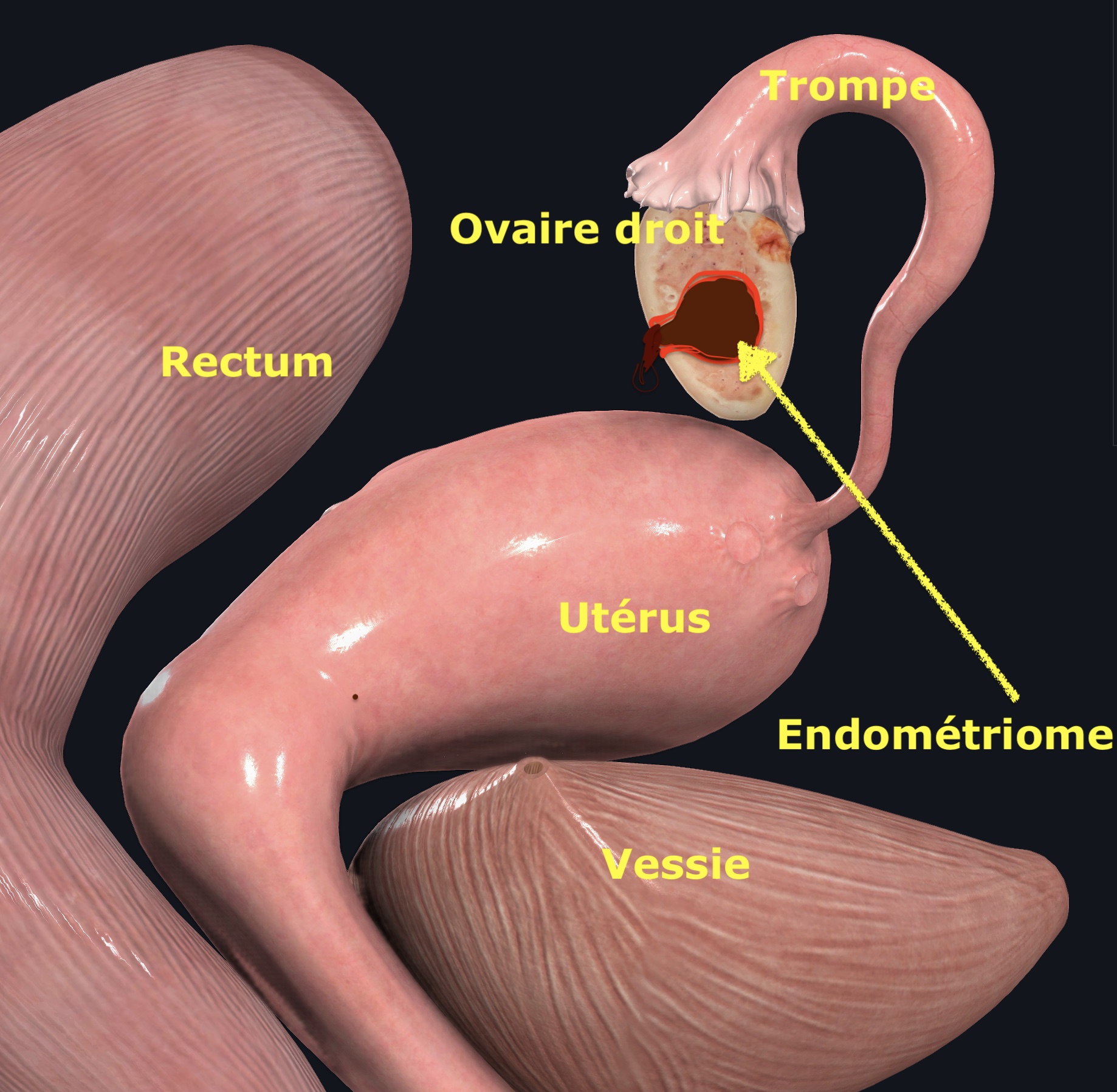
Endometriosis can affect the ovaries, in the form of endometriosis cysts, known as " endometriomas ". Unlike other types of benign cyst, endometriomas have a point of origin on the surface of the ovary, from which the cyst invaginates into the ovary, like a caterpillar into an apple. This point of invagination is usually (95%) adherent to neighbouring organs. 

Mobilization of the ovary during surgery causes adhesions to rupture, immediately opening the endometriomas. The endometriomas are filled with a characteristic chocolate-colored viscous fluid containing degraded blood and cellular debris. This fluid is a favorable environment for bacterial growth, which explains why endometriomas are liable to develop into abscesses, either spontaneously or following puncture.

The wall of an endometrioma has 2 distinct layers:

  • On the inside, a thin layer of endometrial cells, which, by accumulating the fluid contained in the cyst, is responsible for its progression and probably its recurrence.
  • On the outside, a thicker layer (approx. 1 mm) of fibrosis, strongly adherent to the underlying ovarian tissue. The absence of a cleavage plane, and even of a clear boundary under microscopy, means that healthy ovarian tissue can be damaged when traction is exerted on this layer of fibrosis.    
Ovarian endometriosis cyst
Fig3: microscopic view of an endometrioma wall

Endometrioma surgery

Endometrioma surgery can be performed according to 4 main principles:

  • Cystectomy, which involves removal of the cyst wall, i.e. the fibrous layer. This invariably involves removal of part of the underlying ovarian tissue, resulting in a variable reduction in the follicle reserve of the operated ovary.
  • Ablation or vaporization, which involves in situ destruction of the endometrial tissue layer, without attempting to detach the fibrous tissue layer. Ablation is performed using energies (laser or plasma) that do not diffuse heat deep down (thus protecting the underlying ovarian tissue).
  • Sclerotherapy or alcoholization is another ablation technique. Alcohol 95° is instilled inside the cyst, left in place for 10-15 min, to destroy the inner endometrial layer, without affecting the underlying ovarian tissue.
  • Puncture-aspiration or simple drainage of endometriomas can be performed in women with an already impaired ovarian reserve, when the surgeon wishes to minimize the impact of surgical procedures on the ovaries. This technique is generally performed prior to post-operative in vitro fertilization, to facilitate oocyte puncture. Nevertheless, it is followed by a 100% recurrence rate, making it a procedure to be reserved almost exclusively for this indication.
Endometrioma plasma energy ablation

Choice of surgical treatment for endometriomas

Endometrioma surgery is a prime example of individualized patient management.

The choice of surgical technique depends on several parameters:

  • Patient 's age: the younger the patient, the less aggressive the ovarian surgery proposed will be, with preference given to sclerotherapy and vaporization.
  • The desire to become pregnant: the desire to preserve ovarian reserve recommends more vaporization techniques
  • Ovarian reserve: a satisfactory ovarian reserve allows the use of cystectomy, whereas an impaired ovarian reserve recommends simple drainage.
  • When in vitro fertilization is absolutely indicated (destroyed or absent fallopian tubes, altered sperm parameters), simple drainage is recommended in order to preserve the ovarian reserve as much as possible.
  • Advanced age (>40 years) withno desire to become pregnant: cystectomy or even partial oophorectomy are the most suitable techniques, in order to reduce the risk of recurrence.
  • Cyst size: in the case of large endometriomas (>7 cm), cystectomy can be highly deleterious, while vaporization is technically very difficult. For this reason, large endometriomas are best treated with sclerotherapy, or a combination of sclerotherapy and vaporization.

The choice of surgical technique is discussed during the preoperative consultation, but the final decision is made according to the patient's wishes.

In the majority of cases, an ovarian reserve test is performed prior to surgery, in order to ensure that ovarian insufficiency is not overlooked.

In young, unmarried women with large, bilateral or recurrent endometriomas, fertility preservation by oocyte freezing is generally considered before surgery.

Despite complete surgery, endometriomas recur in around 30% of women, within 2 years if menstruation persists. In most cases, these are not recurrences as such, but the appearance of new cysts following ovulation. Blocking ovulation by taking a continuous pill reduces the risk of recurrence by a factor of 3.

For women wishing to become pregnant, natural conception is generally limited to 9-12 months after the return of menstruation, in order to achieve the best ratio between the probability of conception and the risk of recurrence.

Endometriosis
gynecological
in figures

75%

of women operated on for endometriomas by plasma energy vaporization or cystectomy are pregnant 3 years after surgery

50%

of pregnancies after surgery are natural

30%

of recurrences at 24 months in women not taking the pill

SCIENTIFIC ARTICLES CONCERNING ENDOMETRIOSIS OF THE OVAIRES PUBLISHED BY IFEM ENDO SURGEONS :

1: Roman H, Chanavaz-Lacheray I, Mircea O, Berby B, Dehan L, Braund S, Verspyck E, Puscasiu L. Large ovarian endometriomas are associated with high pre-operative anti-Müllerian hormone concentrations. Reprod Biomed Online. 2020 Sep 11:S1472-6483(20)30513-7. doi: 10.1016/j.rbmo.2020.09.008. Epub ahead of print. PMID: 33060013.
2: Darwish B, Roman H. When Opportunity Knocks, Grab Your Chance: Shall Ablation Be Rehabilitated in the Treatment of Endometrioma? J Minim Invasive Gynecol. 2020 Aug 20:S1553-4650(20)30386-1. doi: 10.1016/j.jmig.2020.08.007. Epub ahead of print. PMID: 32828900.
3: Pluchino N, Roman H. Oocyte vitrification offers more space for a tailored surgical management of endometriosis. Reprod Biomed Online. 2020 Nov;41(5):753-755. doi: 10.1016/j.rbmo.2020.07.012. Epub 2020 Jul 18. PMID: 32819840.
4: Roman H. Laparoscopic Sclerotherapy of Large Endometriomas: Is It a Reasonable Approach? J Minim Invasive Gynecol. 2020 Sep-Oct;27(6):1223-1224. doi: 10.1016/j.jmig.2020.05.011. Epub 2020 May 22. PMID: 32446970.
5: Roman H, Chanavaz-Lacheray I; l’équipe Rouendométriose. Le Centre expert de diagnostic et de prise en charge multidisciplinaire de l’endométriose de Rouen : une expérience pilote française [The Rouen Expert center in the diagnosis and multidisciplinary management of endometriosis: A French pilot experiment]. Gynecol Obstet Fertil Senol. 2018 Jul-Aug;46(7-8):563-569. French. doi: 10.1016/j.gofs.2018.06.006. Epub 2018 Jun 22. PMID: 29937108.
6: Roman H. Endometriosis surgery and preservation of fertility, what surgeons should know. J Visc Surg. 2018 Jun;155 Suppl 1:S31-S36. doi: 10.1016/j.jviscsurg.2018.03.002. Epub 2018 Apr 27. PMID: 29709485.
7: Roman H, Ballester M, Loriau J, Canis M, Bolze PA, Niro J, Ploteau S, Rubod C, Yazbeck C, Collinet P, Rabischong B, Merlot B, Fritel X. Synthèse des stratégies et prise en charge chirurgicale de l’endométriose, RPC Endométriose CNGOF-HAS [Strategies and surgical management of endometriosis: CNGOF-HAS Endometriosis Guidelines]. Gynecol Obstet Fertil Senol. 2018 Mar;46(3):326-330. French. doi: 10.1016/j.gofs.2018.02.020. Epub 2018 Mar 9. PMID: 29526793.
8: Chauvet P, Roman H, Gremeau AS, Canis M, Bourdel N. Prise en charge des endométriomes [Management of endometrioma]. Presse Med. 2017 Dec;46(12 Pt 1):1173-1183. French. doi: 10.1016/j.lpm.2017.10.004. Epub 2017 Nov 22. PMID: 29174658.
9: Stochino-Loi E, Darwish B, Mircea O, Touleimat S, Millochau JC, Abo C, Angioni S, Roman H. Does preoperative antimüllerian hormone level influence postoperative pregnancy rate in women undergoing surgery for severe endometriosis? Fertil Steril. 2017 Mar;107(3):707-713.e3. doi: 10.1016/j.fertnstert.2016.12.013. Epub 2017 Jan 12. PMID: 28089574.
10: Mircea O, Puscasiu L, Resch B, Lucas J, Collinet P, von Theobald P, Merviel P, Roman H. Fertility Outcomes After Ablation Using Plasma Energy Versus Cystectomy in Infertile Women With Ovarian Endometrioma: A Multicentric Comparative Study. J Minim Invasive Gynecol. 2016 Nov-Dec;23(7):1138-1145. doi: 10.1016/j.jmig.2016.08.818. Epub 2016 Aug 20. PMID: 27553184.
11: Motte I, Roman H, Clavier B, Jumeau F, Chanavaz-Lacheray I, Letailleur M, Darwish B, Rives N. In vitro fertilization outcomes after ablation of endometriomas using plasma energy: A retrospective case-control study. Gynecol Obstet Fertil. 2016 Oct;44(10):541-547. doi: 10.1016/j.gyobfe.2016.08.008. Epub 2016 Sep 21. PMID: 27665252.
12: Roman H. Politique de FIV systématique chez les patientes avec une endométriose profonde sévère et désir de grossesse : un support scientifique trop fragile pour des dommages collatéraux trop sévères [The policy of systematic first line IVF in patients with severe deep endometriosis and pregnancy intention: A thin scientific support with severe collateral damages]. J Gynecol Obstet Biol Reprod (Paris). 2016 Mar;45(3):211-3. French. doi: 10.1016/j.jgyn.2016.01.005. Epub 2016 Feb 18. PMID: 26900140.
13: Roman H, Quibel S, Auber M, Muszynski H, Huet E, Marpeau L, Tuech JJ. Recurrences and fertility after endometrioma ablation in women with and without colorectal endometriosis: a prospective cohort study. Hum Reprod. 2015 Mar;30(3):558-68. doi: 10.1093/humrep/deu354. Epub 2015 Jan 7. PMID: 25574030.
14: Roman H, Bubenheim M, Auber M, Marpeau L, Puscasiu L. Antimullerian hormone level and endometrioma ablation using plasma energy. JSLS. 2014 Jul- Sep;18(3):e2014.00002. doi: 10.4293/JSLS.2014.00002. PMID: 25392649; PMCID: PMC4208885.
15: Roman H, Auber M, Bourdel N, Martin C, Marpeau L, Puscasiu L. Postoperative recurrence and fertility after endometrioma ablation using plasma energy: retrospective assessment of a 3-year experience. J Minim Invasive Gynecol. 2013 Sep-Oct;20(5):573-82. doi: 10.1016/j.jmig.2013.02.016. Epub 2013 Jun 10. PMID: 23759693.
16: Bourdel N, Roman H, Mage G, Canis M. Chirurgie des endométriomes ovariens: de la physiopathologie à la prise en charge pratique pré-, per- et postopératoire [Surgery for the management of ovarian endometriomas: from the physiopathology to the pre-, peri- and postoperative treatment]. Gynecol Obstet Fertil. 2011 Dec;39(12):709-21. French. doi: 10.1016/j.gyobfe.2011.07.051. Epub 2011 Nov 10. PMID: 22079743.
17: Mokdad C, Auber M, Vassilieff M, Diguet A, Bourdel N, Marpeau L, Roman H. Évaluation par échographie tridimensionnelle de la réduction du volume des ovaires après kystectomie des endométriomes [Assessment of ovarian volume reduction with three-dimensional ultrasonography after cystectomy for endometrioma]. Gynecol Obstet Fertil. 2012 Jan;40(1):4-9. French. doi: 10.1016/j.gyobfe.2011.07.038. Epub 2011 Oct 20. PMID: 22019254.
18: Roman H, Auber M, Mokdad C, Martin C, Diguet A, Marpeau L, Bourdel N. Ovarian endometrioma ablation using plasma energy versus cystectomy: a step toward better preservation of the ovarian parenchyma in women wishing to conceive. Fertil Steril. 2011 Dec;96(6):1396-400. doi: 10.1016/j.fertnstert.2011.09.045. Epub 2011 Oct 22. PMID: 22019124.
19: Auber M, Bourdel N, Mokdad C, Martin C, Diguet A, Marpeau L, Roman H. Ultrasound ovarian assessments after endometrioma ablation using plasma energy. Fertil Steril. 2011 Jun 30;95(8):2621-4.e1. doi: 10.1016/j.fertnstert.2011.04.090. Epub 2011 May 31. PMID: 21621773.
20: Roman H, Pura I, Tarta O, Mokdad C, Auber M, Bourdel N, Marpeau L, Sabourin Vaporization of ovarian endometrioma using plasma energy: histologic findings of a pilot study. Fertil Steril. 2011 Apr;95(5):1853-6.e1-4. doi: 10.1016/j.fertnstert.2010.11.038. Epub 2010 Dec 17. PMID: 21168130.
21: Roman H, Tarta O, Pura I, Opris I, Bourdel N, Marpeau L, Sabourin JC. Direct proportional relationship between endometrioma size and ovarian parenchyma inadvertently removed during cystectomy, and its implication on the management of enlarged endometriomas. Hum Reprod. 2010 Jun;25(6):1428-32. doi: 10.1093/humrep/deq069. Epub 2010 Apr 8. PMID: 20378613.

Get help from a gynecological endometriosis specialist

IFEM Endo, a center specializing in the management of endometriosis and complex forms of the disease, is there to support you throughout your gynecological endometriosis treatment.

Last updated on Tue 2, 2021 @ 12:15 PM